
Social & Cultural History
Social & Cultural History
Villas
The Development & Villas of Woolloomooloo Hill
Excerpted from The Australian Colonial House, by Dr James Broadbent AM, with kind permission
The economic boom of the 1830s had spurred a building boom, driven by immigration and capital influx from Britain, creating a demand for skilled builders and architects. Despite initial slow development, by 1835, most villas had been constructed, fulfilling the conditions set by the government in 1828 (and the expiration of a three-year development requirement for land grantees). The villa conditions aimed to create an ornamental suburb, but compliance varied, and many grantees sought to repeal these conditions to capitalize on their properties.
The Sydney Gazette highlighted the transformation of Woolloomooloo Hill into an elegant suburb, crediting Alexander Macleay for initiating improvements and inspiring others to build villas. By 1832, nine villas were either built or under construction, with John Verge, who had emigrated in 1828, credited for designing several, although only Goderich Lodge can be definitively attributed to him. His contribution to Woolloomooloo Hill established a standard for villa design that influenced the architectural landscape of Sydney throughout the 1830s. His work mirrored Regency and late-Georgian designs from London, distinguished by intricate detailing and catered to the aspirations of the emerging gentry while adapting to the economic and social changes of the time.
The evolution of Woolloomooloo Hill reflected broader trends in colonial Australia, where economic growth and changing social dynamics reshaped urban landscapes. The construction of Grantham in 1836 marked a shift in architectural style and social structure, as it was built by a nouveau riche ironmonger and not subject to villa conditions.
By the 1840s, the original villa conditions were formally rescinded, allowing for further development and commercialization of the area.
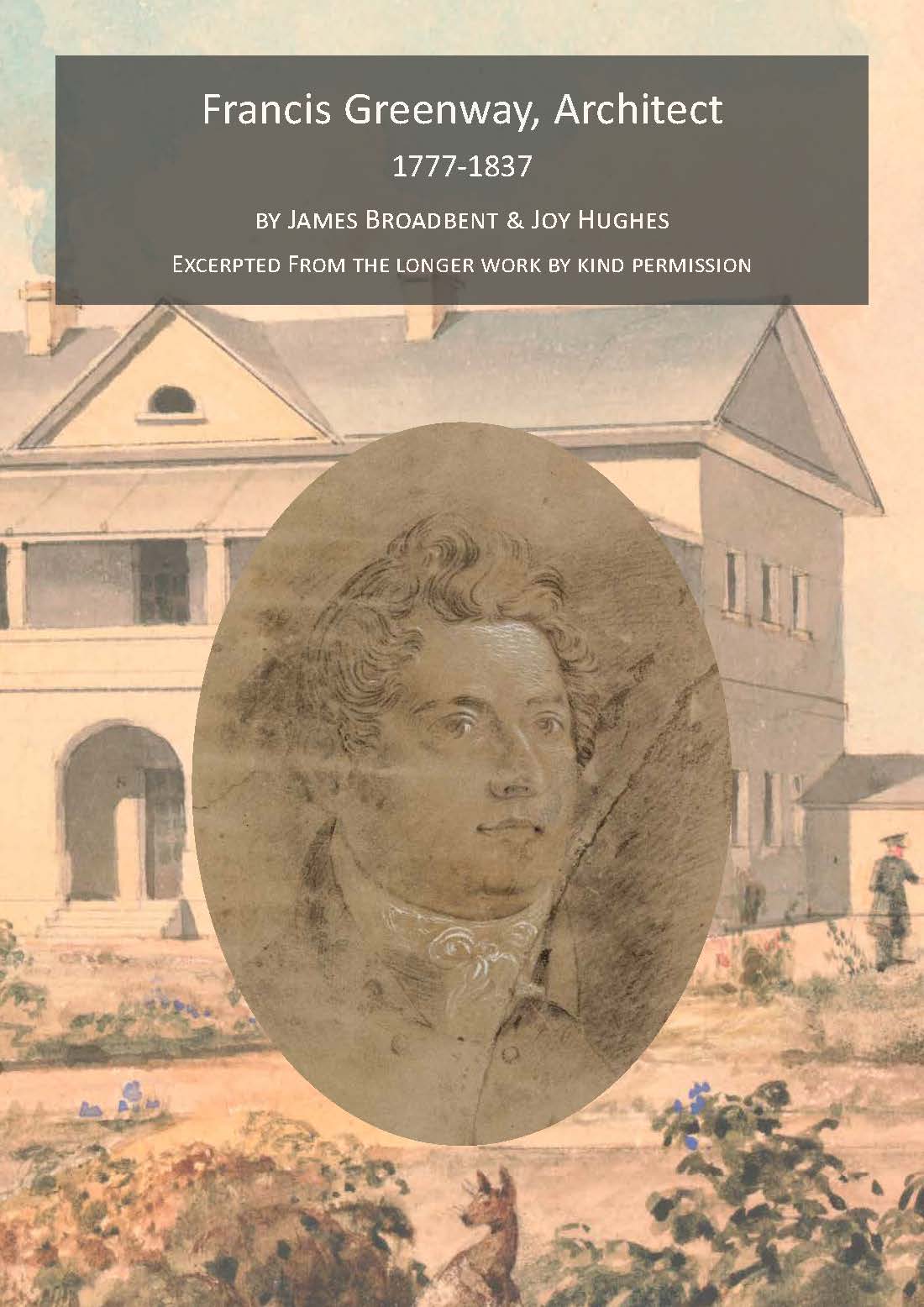
Francis Greenway
(1777-1837)
Francis Greenway (1777-1837) was Australia’s first Government Architect. A convicted forger, he was appointed Actin Civil Architect by Governor Macquarie in 1816.
For seven years he realized the Governor’s schemes for public works that would raise New Souith Wales from a convict outpost to a proud colony.
The relationship ended acrimoniously, but Greenway continued his private practice largely designing houses and stores for prosperous Sydney merchants and influenced the style and architecture of Potts Point villas Grantham and Springfield.
John Verge
(1782-1861)
By Clive Lucas OBE excerpted from Architects of Australia edited by Howard Tanner, used with kind permission.
Of the architects who practiced in Australia during the first half of the 19th Century, it was John Verge who was perhaps the most accomplished in the sense of his output and quality of his work, borne out in the grandeur and design of Elizabeth Bay House.
