
PPPG COMMUNITY SURVEY REPORT: 2024
Survey designed and evaluated by Mark Day
Committee Member PPPG
On behalf of the Potts Point Preservation Group
1. Executive Summary
The Potts Point Preservation Group (PPPG) conducted a comprehensive survey in October/November 2024 to gauge community perspectives on preserving and enhancing the character, heritage, and vibrancy of the Potts Point, Elizabeth Bay, and Rushcutters Bay precincts.
The findings underscore a strong commitment to preserving the area’s cultural and architectural identity while addressing contemporary challenges like redevelopment, housing affordability, and heritage conservation.
Key insights include overwhelming support for initiatives to protect the area’s fundamental character, consolidate heritage efforts, and engage with government bodies. Respondents also voiced concerns about housing affordability and expressed enthusiasm for community-driven regeneration projects.
The results indicate clear and unambiguous support for the PPPG and extend to the political representatives who also support the initiatives of the PPPG.
2. Introduction
Background.
The Potts Point Preservation Group (PPPG) aims to protect and enhance the unique character and heritage of the Potts Point, Elizabeth Bay & Rushcutters Bay. This survey was conducted to understand community perspectives and levels of support on various issues related to preservation, redevelopment, and community engagement.
Objectives of the Survey
-
To gauge the importance of preserving the neighbourhood’s character.
-
To assess support for PPPG’s advocacy efforts.
-
To understand community views on inclusivity, housing, and heritage conservation.
-
To gather feedback on potential regeneration projects and community engagement.
Methodology
The survey was conducted during a four-week period from October 16th 2024 to November 16th 2024. The suite of questions were designed to be simple and easy to follow, with the SurveyMonkey software providing the platform for construction and analysis of the survey.
It was presented online using the Potts Pointers Facebook group which represents a very large and widespread source of our target audience living in the area. The combined population of Elizabeth Bay, Potts Point, and Rushcutters Bay is approximately 15,000 people. A total of 244 respondents participated in the survey.
The survey included multiple-choice questions, allowing respondents to select one or more options where applicable and also some open-ended style questions for freestyle responses.
The results were analysed to identify key trends and insights.
Demographics
-
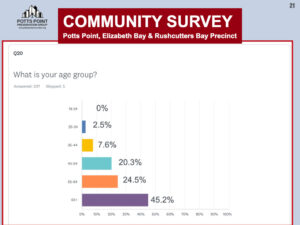
Age Group: The survey results show a higher percentage of older respondents (65+) compared to the ABS data, which indicates a younger median age in Potts Point. (See appendix – Question 20)
-
Rent/Own: The survey results show a higher percentage of homeowners compared to the ABS data, which indicates a higher percentage of renters in Potts Point. (See appendix – Question 19)
-
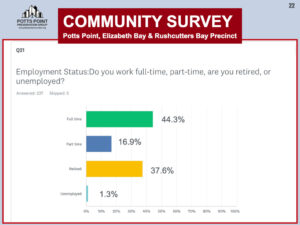
Employment Status: The survey results show a higher percentage of retired respondents compared to the ABS data, which indicates a higher percentage of full-time employed individuals in Potts Point. (See appendix – Question 21)
These comparisons highlight some differences between the survey respondents and the overall demographics of the general population of Potts Point, Rushcutters Bay and Elizabeth Bay. However, given the overwhelmingly clear and unambiguous responses to questions, this does not affect the outcome of the survey results in any meaningful or statistically significant way.
Sample
With a 95% confidence level, the margin of error for the survey results is approximately 6.3%. This means that if the survey were conducted multiple times, the true population parameter would fall within ±6.3% of the survey results 95% of the time.
Reliability
The data collected from the survey is reasonably reliable given the sample size of 244 respondents. However, the margin of error of 6.3% should be taken into account when interpreting the results. Again though, given the overwhelmingly clear and unambiguous responses, the margin of error does not affect the outcome of the results in any meaningful or significant way.
3. Survey Results
Sample Size
-
Total Respondents: 244
Key Findings
Question 1: Preservation of Neighbourhood Character
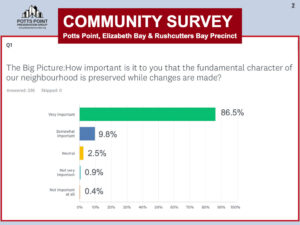
The Big Picture: How important is it to you that the fundamental character of our neighbourhood is preserved while changes are made?
-
Very important: 86.48%
-
Somewhat important: 9.84%
-
Neutral: 2.46%
-
Not very important: 0.82%
-
Not important at all: 0.41%
Findings:
The overwhelming majority of respondents (86.48%) consider it very important to preserve the fundamental character of the neighbourhood while making changes. In fact over 95% of respondents considered preservation of the neighbourhood character ‘important’. This indicates a strong commitment to maintaining the area’s cultural and architectural identity.
Question 2: Advocacy for Preservation Efforts
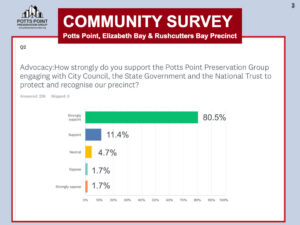
How strongly do you support the Potts Point Preservation Group engaging with City Council, the State Government and the National Trust to protect and recognise our precinct?
-
Strongly support: 80.74%
-
Support: 11.48%
-
Neutral: 4.51%
-
Oppose: 1.64%
-
Strongly oppose: 1.64%
Findings:
A significant majority (over 92%) support or strongly support the PPPG engaging with City Council, the State Government, and the National Trust to protect and recognize the precinct. This reflects strong community backing for advocacy efforts.
Question 3: Inclusivity and Representation
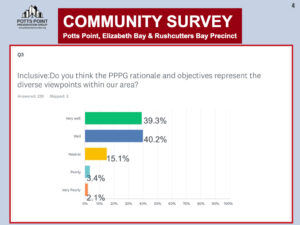
Do you think the PPPG rationale and objectives represent the diverse viewpoints within our area?
-
Very well: 39.83%
-
Well: 39.83%
-
Neutral: 14.94%
-
Poorly: 3.32%
-
Very Poorly: 2.07%
Findings:
The overwhelming majority of respondents (79.66%) believe that the PPPG’s rationale and objectives represent the diverse viewpoints within the area either very well or well. This suggests that the group is seen as inclusive and representative of the community.
Question 4: Effectiveness of Community Engagement
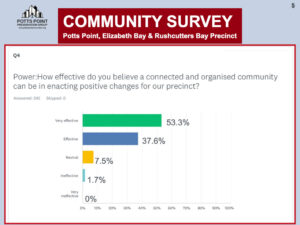
Power: How effective do you believe a connected and organised community can be in enacting positive changes for our precinct?
-
Very effective: 53.69%
-
Effective: 37.30%
-
Neutral: 7.38%
-
Ineffective: 1.64%
-
Very ineffective: 0.00%
Findings:
A majority of respondents (91%) believe that a connected and organized community can be very effective in enacting positive changes for the precinct. This highlights the importance of community engagement and collaboration.
Question 5: Support for Heritage Conservation Area
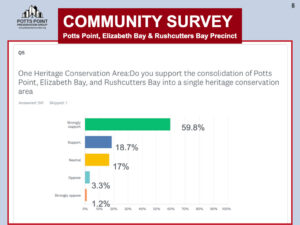
One Heritage Conservation Area: Do you support the consolidation of Potts Point, Elizabeth Bay, and Rushcutters Bay into a single heritage conservation area?
-
Strongly support: 60.08%
-
Support: 18.52%
-
Neutral: 16.87%
-
Oppose: 3.29%
-
Strongly oppose: 1.23%
Findings:
A significant portion of respondents (78%) support the consolidation of Potts Point, Elizabeth Bay, and Rushcutters Bay into a single heritage conservation area. This indicates strong support for heritage conservation efforts.
Question 6: Concerns About Housing Loss
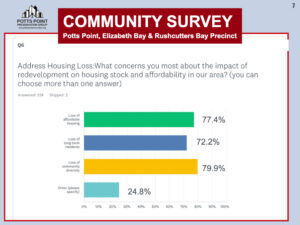
Address Housing Loss: What concerns you most about the impact of redevelopment on housing stock and affordability in our area? (you can choose more than one answer)
-
Loss of affordable housing: 77.69%
-
Loss of long-term residents: 72.31%
-
Loss of community diversity: 79.75%
-
Other: 26.03%
Findings:
This multiple-response question indicates a majority of respondents are concerned about the loss of affordable housing (77.69%), long-term residents (72.31%), and community diversity (79.75%) due to redevelopment. This highlights the need to address housing affordability and community diversity in future planning efforts.
Question 7: Support for Objections to Development Applications
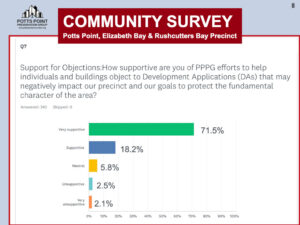
How supportive are you of PPPG efforts to help individuals and buildings object to Development Applications (DAs) that may negatively impact our precinct and our goals to protect the fundamental character of the area?
-
Very supportive: 71.72%
-
Supportive: 18.03%
-
Neutral: 5.74%
-
Unsupportive: 2.46%
-
Very unsupportive: 2.05%
Findings:
A majority of respondents (71.72%) are very supportive of PPPG efforts to help individuals and buildings object to Development Applications (DAs) that may negatively impact the precinct. With some 90% support, this indicates strong community endorsement for protecting the area’s character.
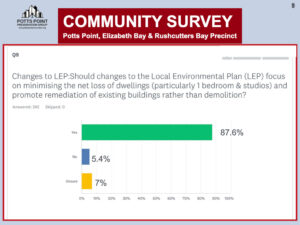
Question 8: Changes to Local Environmental Plan (LEP)
Changes to LEP: Should changes to the Local Environmental Plan (LEP) focus on minimising the net loss of dwellings (particularly 1-bedroom & studios) and promote remediation of existing buildings rather than demolition?
-
Yes: 87.70%
-
No: 5.33%
-
Unsure: 6.97%
Findings: The majority of respondents (87.70%) believe that changes to the Local Environmental Plan (LEP) should focus on minimizing the net loss of dwellings and promoting remediation of existing buildings rather than demolition. This reflects a preference for preservation over redevelopment.
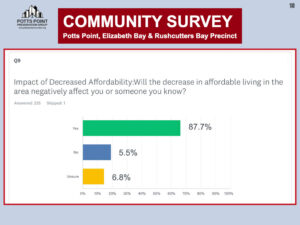
Question 9: Impact of Decreased Affordability
Will the decrease in affordable living in the area negatively affect you or someone you know?
-
Yes: 67.08%
-
No: 18.93%
-
Unsure: 13.99%
Findings:
A significant portion of respondents (67.08%) believe that the decrease in affordable living in the area will negatively affect them or someone they know. This underscores the importance of addressing housing affordability in future planning efforts.
This highlights a very telling and human aspect to the issue of housing affordability as it affects two out of three people in the neighbourhood.
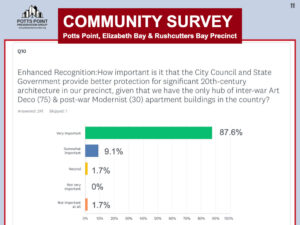
Question 10: Enhanced Recognition of 20th-Century Architecture
Enhanced Recognition: How important is it that the City Council and State Government provide better protection for significant 20th-century architecture in our precinct, given that we have the only hub of inter-war Art Deco (75) & post-war Modernist (30) apartment buildings in the country?
-
Very important: 87.65%
-
Somewhat important: 9.05%
-
Neutral: 1.65%
-
Not very important: 0.00%
-
Not important at all: 1.65%
Findings:
The overwhelming majority of respondents (87.65%) consider it very important that the City Council and State Government provide better protection for significant 20th-century architecture in the precinct. This indicates strong support for heritage conservation efforts.
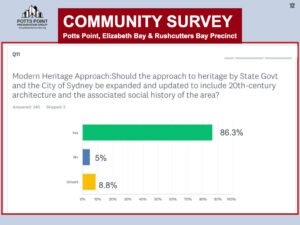
Question 11: Modern Heritage Approach
Should the approach to heritage by State Govt and the City of Sydney be expanded and updated to include 20th-century architecture and the associated social history of the area?
-
Yes: 86.36%
-
No: 4.96%
-
Unsure: 8.68%
Findings:
A significant portion of respondents (86.36%) believe that the approach to heritage by the State Government and the City of Sydney should be expanded and updated to include 20th-century architecture and the associated social history of the area. This reflects a preference for a more inclusive approach to heritage conservation.
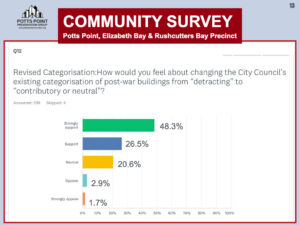
Question 12: Revised Categorisation of Post-War Buildings
Revised Categorisation: How would you feel about changing the City Council’s existing categorisation of post-war buildings from “detracting” to “contributory or neutral”?
-
Strongly support: 48.75%
-
Support: 26.25%
-
Neutral: 20.42%
-
Oppose: 2.92%
-
Strongly oppose: 1.67%
Findings:
An overwhelming majority of respondents (75%) either support or strongly support changing the City Council’s existing categorisation of post-war buildings from “detracting” to “contributory or neutral.” This indicates a preference for recognizing the value of post-war architecture.
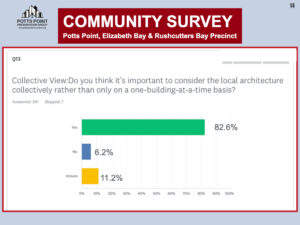
Question 13: Collective View of Local Architecture
Do you think it’s important to consider the local architecture collectively rather than only on a one-building-at-a-time basis?
-
Yes: 82.72%
-
No: 6.17%
-
Unsure: 11.11%
Findings:
The overwhelming majority of respondents (82.72%) believe it’s important to consider the local architecture collectively rather than only on a one-building-at-a-time basis. This reflects a preference for a holistic approach to heritage conservation.
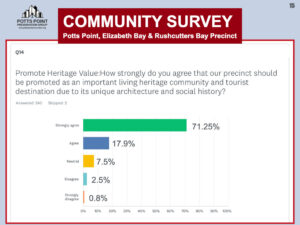
Question 14: Promotion of Heritage Value
How strongly do you agree that our precinct should be promoted as an important living heritage community and tourist destination due to its unique architecture and social history?
-
Strongly agree: 71.49%
-
Agree: 17.77%
-
Neutral: 7.44%
-
Disagree: 2.48%
-
Strongly disagree: 0.83%
Findings:
The majority of respondents (71.49%) strongly agree that the precinct should be promoted as an important living heritage community and tourist destination due to its unique architecture and social history. This indicates strong support for promoting the area’s heritage value.
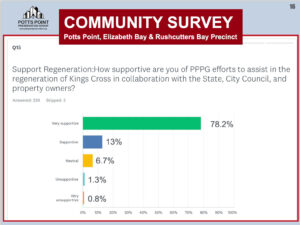
Question 15: Support for Regeneration of Kings Cross
How supportive are you of PPPG efforts to assist in the regeneration of Kings Cross in collaboration with the State, City Council, and property owners?
-
Very supportive: 78.42%
-
Supportive: 12.86%
-
Neutral: 6.64%
-
Unsupportive: 1.24%
-
Very unsupportive: 0.83%
Findings:
The majority of respondents (91.28%) are supportive of PPPG efforts to assist in the regeneration of Kings Cross in collaboration with the State, City Council, and property owners. This reflects strong community support for regeneration projects.
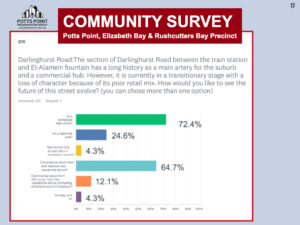
Question 16: Future of Darlinghurst Road
Darlinghurst Road: The section between the train station and El-Alamein Fountain has a long history as a main artery for the suburb and a commercial hub. However, it is currently in a transitional stage with a loss of character because of its poor retail mix. How would you like to see the future of this street evolve? (you can choose more than one option)
-
As a revitalised high street: 72.92%
-
As a nightclub area: 24.58%
-
Residential only: 4.17%
-
Commercial street-front with medium-rise residential above: 64.58%
-
Commercial street-front with super high-rise residential above: 12.08%
-
It’s okay as it is: 4.17%
Findings:
The majority of respondents (72.92%) would like to see Darlinghurst Road evolve as a revitalised high street. This indicates a preference for enhancing the street’s commercial and social vibrancy. Additionally, 64.58% of respondents support the idea of having a commercial street-front with medium-rise residential above, reflecting a desire for a mixed-use development that combines commercial and residential spaces. The relatively lower support for other options, such as a nightclub area (24.58%) and super high-rise residential (12.08%), suggests that the community favours a balanced approach to development that maintains the area’s character while promoting economic activity.
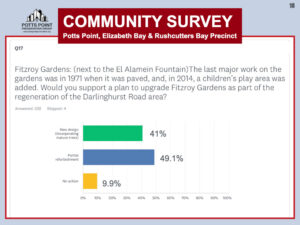
Question 17: Fitzroy Gardens Upgrade
Fitzroy Gardens (next to the El Alamein Fountain): The last major work was in 1971 when it was paved and, in 2014, a children’s play area was added. Would you support a plan to upgrade Fitzroy Gardens as part of the regeneration of the Darlinghurst Road area?
-
New design (incorporating mature trees): 40.83%
-
Partial refurbishment: 49.17%
-
No action: 10.00%
Findings:
Findings: A significant portion of respondents (49.17%) support a partial refurbishment of Fitzroy Gardens as part of the regeneration of the Darlinghurst Road area. This suggests that the community favours improvements to the gardens while maintaining some of its existing features. Additionally, 40.83% of respondents support a new design that incorporates mature trees, reflecting a desire for a more comprehensive upgrade that enhances the garden’s aesthetic and environmental value. Only a small percentage of respondents (10.00%) prefer no action, indicating that the majority of the community is in favour of some form of upgrade to Fitzroy Gardens. These findings further highlight the community’s passionate interest in enhancing public spaces and contributing to the overall regeneration of the area.
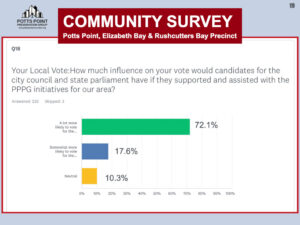
Question 18: Your Local Vote
Your Local Vote: How much influence on your vote would candidates for the city council and state parliament have if they supported and assisted with the PPPG initiatives for our area?
-
A lot more likely to vote for the candidate: 71.78%
-
Somewhat more likely to vote for the candidate: 18.26%
-
Neutral: 9.96%
Findings:
The majority of respondents (71.78%) indicated that they would be a lot more likely to vote for candidates who support and assist with the PPPG initiatives. This suggests that the community places significant value on candidates who prioritize preservation and enhancement efforts in the Potts Point, Elizabeth Bay, and Rushcutters Bay precincts. Additionally, 18.26% of respondents would be somewhat more likely to vote for such
candidates, further emphasizing the importance of these initiatives in influencing local voting behaviour. The relatively small percentage of neutral responses (9.96%) indicates that most respondents have a clear stance on this issue.
FREESTYLE QUESTIONS
Question 22: Reason for Choosing the Area
Why do you choose to live in or visit this area?
92% of respondents responded to this question affirming a positive view of the community and with common reasons for choosing the area such as diversity, density, walkability, safety, history, architecture, inclusivity, amenity, proximity to city, attractiveness and character.
Examples include:
-
Diverse community, architecture (character buildings), natural environment
-
I’ve lived there and have friends living there; the character, diversity, and history of creative energy and good food and cafes
-
Community and connections. Work is close. Safety.
-
The diversity
-
Dense urban environment with all amenities
-
High walkability, good shopping and transport, diverse population, access to parks and greenery, proximity to CBD
-
Its charm, parks, harbour, air and access to city, and public transport; cosmopolitan feel
-
Have always lived here
-
Friendliness and inclusiveness; concern that redevelopment could diminish these qualities
-
High density, walkable, attractive, close to city and harbour
-
Close to the city and harbour, beautiful old buildings, diverse demographic mix
-
The community and diversity
-
Central with a village vibe
-
Vitality, no need for a car
Question 23: Other Comments
Do you have any additional comments or suggestions on how we can achieve our goals for preserving and enhancing the Potts Point, Elizabeth Bay, and Rushcutters Bay precinct?
Examples of some open-ended answers which reflect the sentiment of a most of the
responses are:
-
We have three hospitals nearby and several aged care facilities, a fire station and police. Where will essential workers with short shift turnarounds live if we keep having studios and one bedders replaced with luxury accommodation?
-
Future unaffordability for our kids
-
They are killing the vibe
-
I don’t like the increase in often unoccupied trophy apartments
-
Loss of mix of residents from all socio-economic levels
-
Thank you for this desperately needed group which is similar to why much of Paddington where I lived previously, was preserved. Now the same needs to be done for nearby historic Darlinghurst.
Some alternative views:
-
I have no issue with redevelopment. The world moves on. We can’t live in a time capsule.
-
We need larger apartments for families.
APPENDIX: SURVEY RESULTS TAKEN FROM SURVEY MONKEY ANALYSIS
(Note: for easier viewing percentages have been placed next to coloured bars and rounded to one decimal point)
QUESTION 1
QUESTION 2
QUESTION 3
QUESTION 4
QUESTION 5
QUESTION 6
QUESTION 7
QUESTION 8
QUESTION 9
QUESTION 10
QUESTION 11
QUESTION 12
QUESTION 13
QUESTION 14
QUESTION 15
QUESTION 16
QUESTION 17
QUESTION 18

QUESTION 19
QUESTION 20
QUESTION 21